Is the Nothing Phone 3 better than the Dji Osmo Mobile 8? We Tested Both
Comparisons that put a smartphone and a handheld gimbal head-to-head are always attention-grabbing because they force a useful question: can a modern phone replace a dedicated stabilizer, or does a gimbal still offer irreplaceable benefits? This article examines the Nothing Phone 3 and the Dji Osmo Mobile 8 after hands-on testing in real-world scenarios—city walking tours, short travel vlogs, interview-style clips, and fast-moving sports footage. The goal is practical: help buyers who care about video quality, portability, battery life, ease of use, and value decide which product better suits their needs.
Why this comparison matters
Buyers usually care about three things when choosing gear for mobile video: final image stability and quality, how easy the kit is to use on the move, and whether the purchase is justified for the types of videos they make. The Nothing Phone 3 is a complete smartphone with an integrated camera system. The Dji Osmo Mobile 8 is a tool built to make any compatible phone's footage smoother and more cinematic. Comparing them isn't about declaring an absolute winner; it's about answering whether the Phone 3 can make a gimbal unnecessary for a specific user.
Testing methodology
Testing focused on practical use rather than lab benchmarks. Sessions included:
- Handheld daytime walking shots using the Nothing Phone 3 in standard and stabilized modes.
- The same shots repeated with the Phone 3 mounted on the Osmo Mobile 8 to evaluate the difference a three-axis gimbal makes.
- Low-light handheld night streets tests with and without the gimbal.
- Vlogging and selfie-style clips to test framing, ActiveTrack/face tracking, and ease of setup.
- Long takes to assess ergonomics and battery behavior over sessions lasting 60–120 minutes.
Detailed product analysis
Nothing Phone 3 — the smartphone angle
The Nothing Phone 3, as the phone in this comparison, is evaluated primarily for its camera system, computational stabilization, and general suitability as a one-device video kit. Modern phones increasingly combine optical stabilization, electronic image stabilization, and software-based steadiness to deliver impressive handheld footage. The Phone 3 benefits from being a single device that handles capture, editing, and upload without peripherals.
Strengths noticed during testing include responsive camera software that switches quickly between modes, competent in-camera stabilization for short clips, and very good color science for daylight scenes. For casual creators—social clips, short reels, quick travel stories—the Phone 3 produced tidy, shareable footage straight out of the camera with minimal setup.
Limitations became clearer in extended movement shots and when the camera operator attempted cinematic pans or long, smooth tracking shots. Even with the phone’s stabilization engaged, there is a tactile difference: small micro‑jitters remain when walking, and fluid rotational moves (slow, even pans that reveal a scene) looked noticeably smoother when the phone was mounted to a gimbal.
Dji Osmo Mobile 8 — the stabilizer perspective
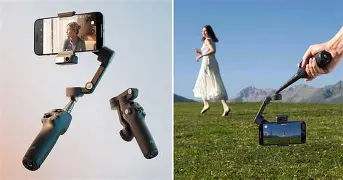
The Dji Osmo Mobile 8 is a smartphone gimbal designed to remove the remaining motion artifacts that even the best phone stabilization can't eliminate. In testing it with the Phone 3, the gimbal offered markedly smoother motion during walking shots, cleaner follow sequences, and much easier framing for moving subjects thanks to more robust tracking controls.
Shop the latest Mobile Phones picks on Amazon.
View Offers →Practical observations: setting up the gimbal took slightly longer than a bare-phone startup (unfolding, balancing or using a magnetic clamp), but once ready it allowed longer, more deliberate takes without fatigue. The physical handle and motors make certain moves—180° pans, stabilized low-angle pushes, and controlled crane-like tilts—far more reliable than freehand. The Dji app's creative modes (timelapse, hyperlapse, motionlapse, and portrait/landscape auto-switch) were helpful for variety in short productions.
Gimbal drawbacks are predictable: added packaged weight, another device to charge, and slightly slower handheld spontaneity. For a user who needs quick snaps or is traveling extremely light, the gimbal may feel like extra baggage. For those making longer videos, interviews on the move, or wedding-style coverage, the gimbal rapidly repays its bulk by reducing post‑stabilization work and delivering more professional motion.
Pros & cons
Nothing Phone 3 — Pros
- Strong all-in-one convenience: capture, edit, and share from one device.
- Good daylight image quality and usable stabilization for casual content.
- Minimal setup and instant readiness for spontaneous shooting.
- Lower total kit weight for travel and day-long carry compared with phone+gimbal.
Nothing Phone 3 — Cons
- Even with software stabilization, long tracking shots show micro‑vibrations.
- Limited creative motion control compared with a gimbal (no motorized pans/tilts).
- Less comfortable for long handheld sessions; many operators will feel wrist fatigue faster.
Dji Osmo Mobile 8 — Pros
- Superior stabilization for walking, tracking, and cinematic motion shots.
- Precise subject tracking and creative shooting modes that expand storytelling options.
- Ergonomic handle for longer takes and smoother operator movements.
- Reduces the need for heavy post-production stabilization and warping.
Dji Osmo Mobile 8 — Cons
- Extra device to carry, charge, and learn—less instant than phone-only shooting.
- Upfront time to mount and balance (though modern magnetic clamps speed this up).
- Added weight can matter on long hikes or minimalist travel setups.
Side-by-side comparison
| Feature | Nothing Phone 3 | Dji Osmo Mobile 8 |
|---|---|---|
| Primary role | All-in-one smartphone with integrated camera and stabilization | Dedicated 3-axis gimbal designed to stabilize and expand smartphone video |
| Stabilization outcome | Excellent for short handheld clips and casual use; still some micro-jitters in long takes | Superior smoothing for walking, tracking and cinematic motion shots |
| Low-light performance | Relies on sensor, optics and computational processing—good for photos and decent for video | Helps reduce motion blur by stabilizing the phone; does not improve sensor sensitivity |
| Portability | Very portable—single device to carry | Portable but adds bulk and weight to a travel kit |
| Learning curve | Minimal—familiar smartphone UI | Modest—requires setup, app pairing, and practice for advanced moves |
| Battery and runtime | Phone battery runs camera apps; heavy video use shortens device runtime | Gimbal has its own battery; can extend shooting sessions but requires separate charging |
| Value proposition | One device covers many use cases—best for general users | Adds professional motion control—best for creators focused on video quality |
Real-world use cases and recommendations
Travel and street photography
For a traveler who values light packing and quick captures, the Phone 3 shines. It removes setup delays and lets users capture moments instantly. If the primary output is social clips or travel diaries under two minutes, the phone alone will usually suffice.
Vlogging and solo creators
Solo vloggers who frequently move while speaking to camera will appreciate the gimbal’s smooth follow shots and framing support. ActiveTrack-like features on a gimbal make it easier to keep the subject centered while walking, delivering a more watchable result without extensive editing.
Event videography and interviews
Event shooters or small production teams who need long takes, steady moving shots, or polished cinematic moves will find the gimbal compelling. It reduces the time spent stabilizing and reframing in post and allows cleaner, more deliberate camera movement during interviews and coverage.
Short-form social clips
Short, vertical reels that prioritize speed and spontaneity often favor phone-only workflows. If the user values speed over cinematic polish, the Phone 3 covers most needs—especially when paired with simple handheld techniques and basic editing tools on the device.
Looking for the best Mobile Phones deals on Amazon?
View Offers →Buying guide: How to decide
Use this checklist to decide whether to buy only the Nothing Phone 3, only the Dji Osmo Mobile 8, or both.

Ask these questions first
- What type of content is made most often? If video is occasional and short, a phone suffices. If the content is motion-heavy or intended to look professional, a gimbal is justified.
- How important is speed and portability? If packing light and instantaneous capture matter most, prefer the phone-only route.
- Will the phone be used for long handheld sessions? For long vlogs or many continuous shots, a gimbal improves ergonomics and consistency.
- How much time can be spent learning gear? Gimbals require some practice to get the most out of their modes; if time for learning is limited, decide accordingly.
Technical checks before buying a gimbal
- Confirm physical compatibility with the phone (size, weight, and whether the phone needs a case removed).
- Check the gimbal’s payload limit to ensure stable performance with the chosen phone and any accessories (lenses, microphones).
- Review app features—tracking reliability and creative modes matter more than a glossy spec sheet for many creators.
- Consider battery life and whether the gimbal can charge the phone or be charged conveniently between shoots.
- Look for a foldable design and carrying case if travel convenience is a priority.
Budget guidance
Think of the decision as choosing a studio upgrade versus a primary device. The smartphone is the primary device: it will be used for daily tasks long after the purchase. A gimbal is a targeted investment to raise production value. For many creators, starting with the phone and adding a gimbal later is a sensible path when workflows or client expectations justify the extra spend.
Final verdict
Is the Nothing Phone 3 better than the Dji Osmo Mobile 8? The short answer is: it depends on what "better" means for the buyer. The Nothing Phone 3 is better as an all-purpose, everyday tool—fast to use, lighter to carry, and capable of producing very good casual video without extra gear. The Dji Osmo Mobile 8 is better for anyone whose priority is consistently smooth motion, cinematic camera moves, or professional-looking tracking shots where the phone’s internal stabilization alone cannot deliver the desired result.
In testing, the Phone 3 produced excellent, share-ready footage for spontaneous capture and short-form content. Adding the Osmo Mobile 8 elevated the same footage into noticeably more cinematic territory: walking sequences were steadier, pans and reveals were smoother, and follow shots were more reliable. For creators who prioritize production quality—wedding shooters, documentary-makers, and active vloggers—the gimbal continues to be an important tool. For casual shooters, travelers, and those who prize simplicity, the Nothing Phone 3 alone will often be the smarter, lighter choice.
Ultimately, the decision is pragmatic. Choose the Nothing Phone 3 for convenience and speed. Choose the Dji Osmo Mobile 8 when control over motion and the resulting image aesthetics matter most. Both have clear strengths; combined, they form a flexible kit that covers almost every modern mobile video need.